AppSec hiring
Hire AppSec engineers who can find the bug and explain the fix.
The OWASP Top 10 is common knowledge. The job is spotting the subtle flaw in code you have never seen, explaining how it would be exploited and what should change. Put candidates in front of real code and live applications, and see who can.
Python, Java, JavaScript, Go · Live web apps · Built from your job spec
Trusted by cyber security teams at








At a glance
What is an AppSec engineer assessment?
An AppSec engineer assessment is a hands-on test of secure code review and application testing. Candidates read real application code, find the vulnerabilities, explain how they would be exploited and what should change, and attack live web applications, before anyone is interviewed.
- Environments
- Code review in the browser, live vulnerable web applications
- Languages
- Python (Django, Flask), Java (Spring Boot, servlets), JavaScript (Node.js, Express, React) and Go
- Level
- Junior, mid-level or senior. Tell us the level and we build it to that difficulty.
- Length
- Sized to your process. The ready-made assessment is six challenges, under two hours; a first screen needs two or three.
- Answers
- Findings and written explanations of the risk and the fix. Written answers are marked blind by your team.
- Integrity
- Three modes, up to webcam proctoring with consent. Signals sit next to every score.
- Delivery
- A link, a secure bulk upload or straight from your ATS, in your branding.
Why hiring managers use it
Test the overlap nobody else tests.
Generic cyber interviews miss the code. Generic coding tests miss the security lens. AppSec lives in the overlap, so that is what the assessment measures.
-
Real code, in the languages you use.
Python, Java, JavaScript and Go, across the frameworks your teams build on. Candidates read unfamiliar code and find what is actually wrong with it.
-
The find, the exploit and the fix.
Naming a vulnerability class is a minimum bar. Candidates explain how the flaw would be used and what should change, which is the part your developers will rely on.
-
Live applications to break.
Web application labs with real flaws, from server-side request forgery to broken access control. Candidates find and exploit the issue rather than describe it.
-
Written answers, marked fairly.
Explanations are marked blind against a rubric, so the reasoning is judged on its merit and every candidate is held to the same standard.
What candidates work on
The ready-made AppSec engineer assessment.
Six hands-on challenges across code review and application testing, set at mid-level. We tailor it to your job spec and the languages your teams use.
Secure code review
- React Profile Rendering Review
- Secure Code Review - Python Flask REST API
- JavaScript Preference Merge Review
- Secure Code Review - Java Spring Boot - XXE + JWT alg:none
Application testing
- CTF: Employee Portal
Build and container security
- Code Review: Dockerfile Security
6 challenges · about 105 minutes as listed · trim or swap any of them for your role
One case, end to end
What a strong answer actually looks like.
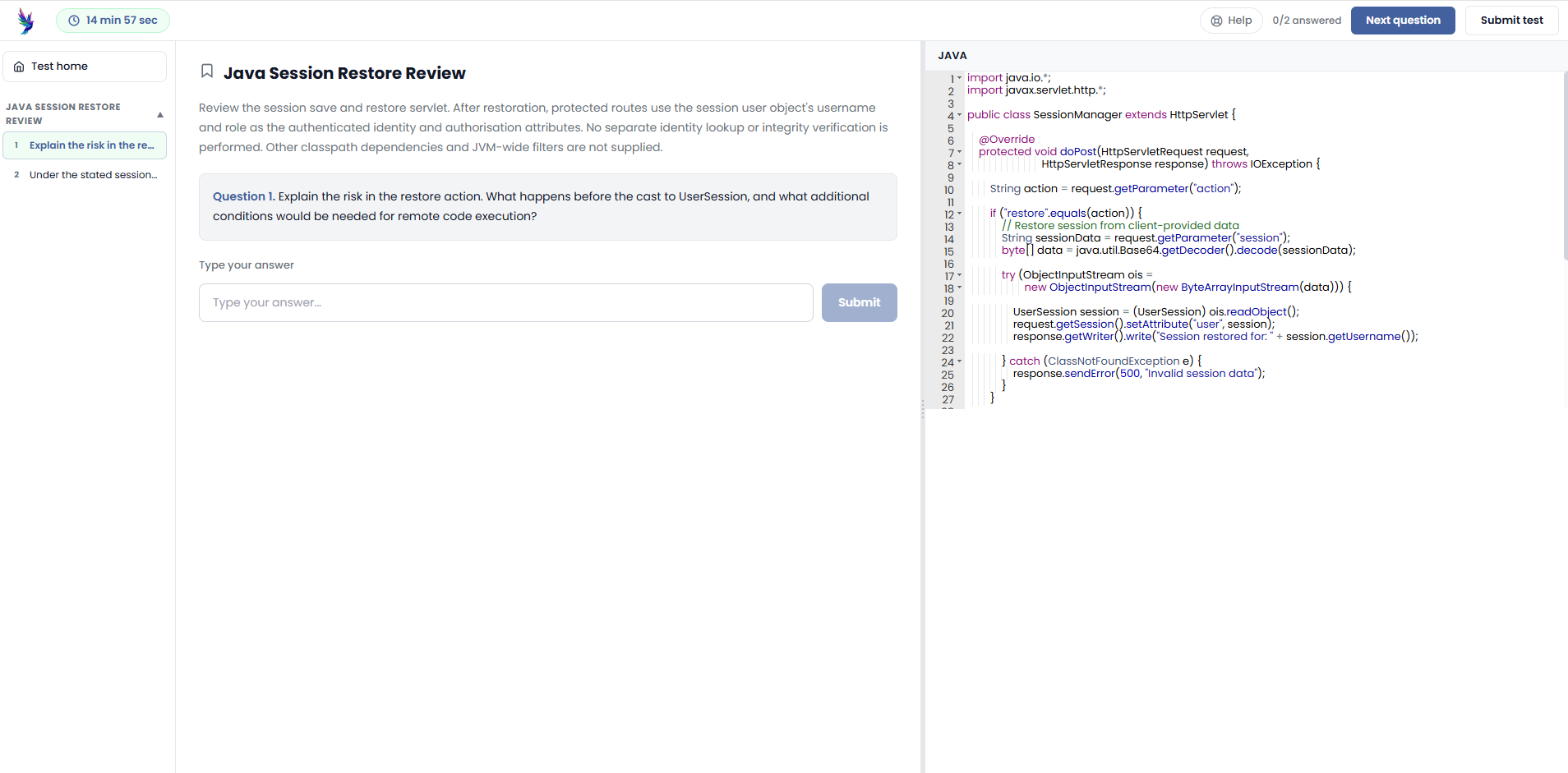
A servlet saves and restores user sessions. After a restore, protected routes trust the session's username and role as the caller's identity. Explain the risk in the restore action, what would have to be true for it to become remote code execution, and what the design fix is.
Explains the risk in their own words, separates what is possible from what is guaranteed and says what it depends on, sees the simpler abuse that needs no exploit at all, and recommends a design fix rather than a patch.
Names the vulnerability class and stops, or claims guaranteed remote code execution without saying what that would depend on.
Free, before you commit to anything
See it before a candidate does.
Tell us the role. We build a hands-on application security engineer assessment for it, in your branding, and send you a private link to sit it yourself. If it is not right for your team, you have lost nothing.
- 01 Tell us the role Send the job spec or just the role title. A job description helps but is not required.
- 02 We build it for you We turn the spec into a hands-on application security engineer assessment from real challenges, at the right level, in your branding.
- 03 Invite your applicants You get a private link to try it first. When you are happy, send it to your applicants. That is it.
What you get back
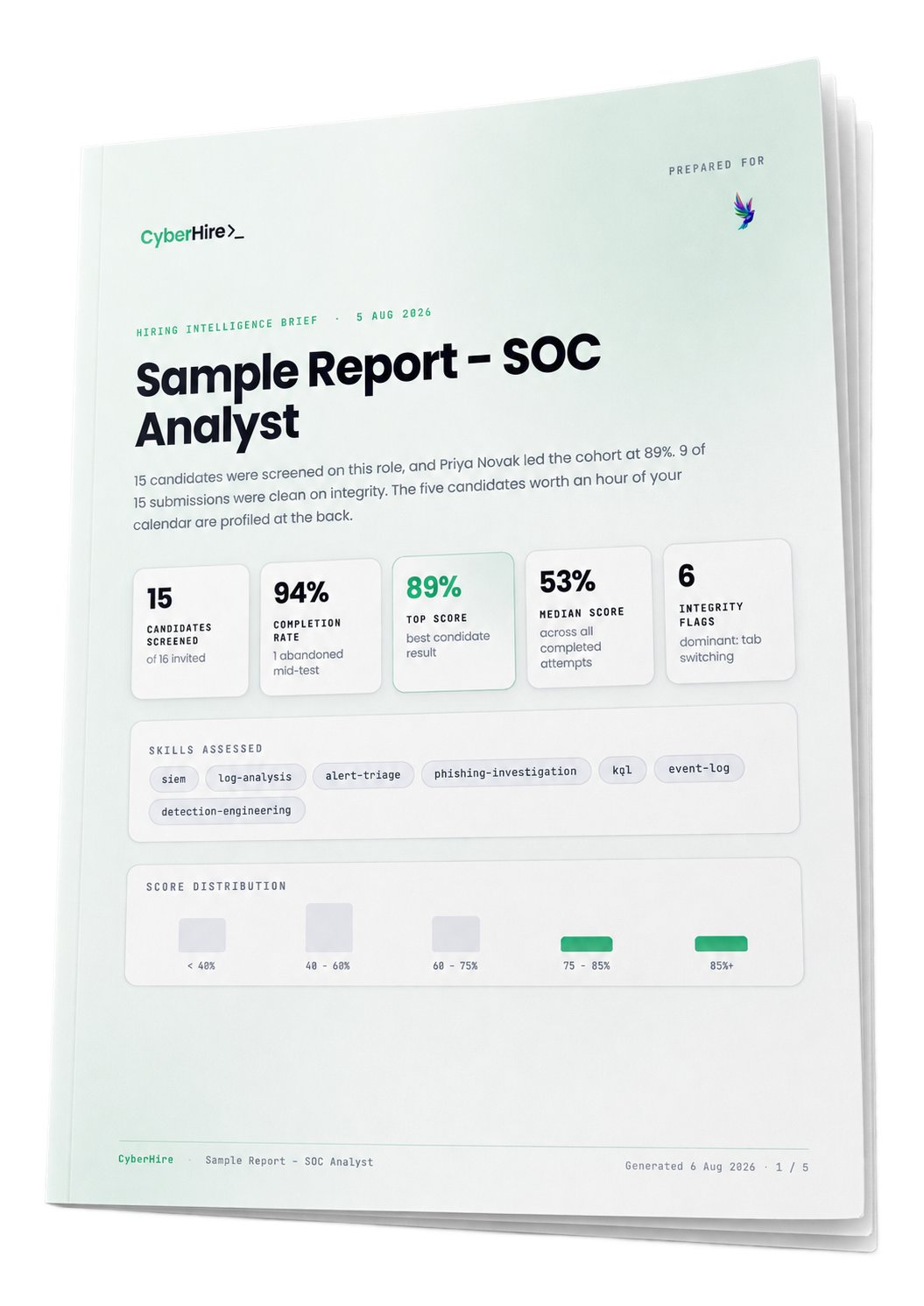
Evidence for every candidate. Read in two minutes.
Results arrive in your workspace as candidates finish, and as a hiring report you can forward to anyone on the panel, including people who never log in. Connected to your ATS, the result is written back to the candidate record.
- Ranked, scored the same way Every candidate on the same challenges and the same answer key, ranked on what they did.
- A score per skill Where each candidate is strong and where they are thin, with their actual answers underneath.
- What to probe at interview For every candidate: the skills they were weakest on and the questions behind it.
- Integrity next to every score Time away, outside pasting, fullscreen exits and second screens, flagged for you to weigh.
How it runs
From job spec to evidence you can act on.
- 01
Send us the role
Fill in the form with the job spec, or just the role title. That is all we need from you.
- 02
We build your assessment
Hands-on, built to your role and level, in your branding, and ready to send. Change anything you like, or send it exactly as it is.
- 03
Invite candidates
A link, a secure bulk upload or straight from your ATS. Everyone reviews the same code.
- 04
Candidates do the work
In a code viewer and live applications, in your branding, with integrity monitoring on.
- 05
Read the evidence
A ranked cohort, a score per skill, the questions to probe with each candidate and any integrity signals. Written answers are marked blind.
Questions we get asked
AppSec hiring questions, answered.
How do you assess an AppSec engineer before interview?
Give them real code with real flaws in it and ask what is wrong, how it would be exploited and what should change. Add a live web application to attack. Score all of it, then use the interview to explore how they would work with your development teams.
Which languages can you test?
Hands-on code review covers Python, Java, JavaScript and Go, across frameworks such as Django, Flask, Spring Boot, Express and React. We build the assessment from your job specification, weighted to the languages your teams use.
How are written answers marked?
Blind. Your team marks them against a rubric without seeing who wrote them, and the candidate's score is not final until they are marked. Unmarked answers are never counted as wrong.
Can candidates use AI to find the bug?
Every attempt is monitored for time away from the test, outside pasting, fullscreen exits and second screens, and every signal sits next to the score. Explaining the risk in this specific code, and what the fix depends on, is harder to fake than naming a vulnerability class.
Do we still need to interview?
Yes. The assessment shows who can find and explain real flaws. The interview then goes on design trade-offs, how they work with developers and the areas the assessment flagged.
Go deeper
How we think about AppSec assessment
None of it is gated.
Try it on your role
See the AppSec assessment built for your role.
Send us the job spec. We build the assessment around it, in your branding, and you try it yourself first. Free, and with no commitment.