How to choose a cyber hiring assessment
Most cyber hiring assessments test what candidates know. The good ones show you what they can actually do. Here's how to tell the difference before you buy.
 11 min read
A cyber hiring assessment evaluates a candidate’s knowledge, practical skills or judgement against the requirements of a cyber security role. To choose one, check what candidates actually do, how their work is scored and what evidence you receive. The assessment should help you screen applicants before interview or evaluate a shortlist alongside interviews.
A useful starting point is the decision you need to make. Are you identifying applicants worth a technical interview? Or comparing candidates who have already interviewed well? Both need evidence of ability, but the scope and depth of the assessment may differ.
This guide explains the main formats, what to look for in the results and how to choose an assessment that fits your hiring process.
What should a cyber hiring assessment measure?
Start with the work the person will own. A SOC analyst may need to investigate alerts and explain an escalation. A cloud security engineer may need to review identity permissions. An application security engineer may need to find a flaw in unfamiliar code and propose a practical fix.
Each task needs a different assessment. A broad security knowledge score does not tell you which of these things a candidate can do.
The NIST NICE Framework separates cybersecurity work into tasks and the knowledge and skills needed to perform them. That is a useful basis for defining what to assess, rather than selecting questions because they fit a job title.
Before choosing a test, write down:
- The tasks the person must handle when they join.
- The tools and environments they need to work in.
- The level of independence expected.
- The skills you can develop after hiring.
Keep those distinctions visible when reviewing results. A candidate who needs to learn your interface is a different proposition from one who cannot explain their investigation.
What are the main types of cyber security hiring assessment?
Three common formats are knowledge tests, focused hands-on tasks and broader simulated exercises. They overlap: a cyber range can host individual tasks, and a single assessment can combine several formats.
| Format | What candidates do | Evidence it can provide | What to check |
|---|---|---|---|
| Knowledge and scenario questions | Choose an answer or explain a response to a described problem | Understanding of concepts, interpretation and proposed decisions | Whether the questions go beyond definitions and match the role |
| Role-specific hands-on tasks | Investigate logs, write queries, review code or analyse configuration | Work produced on a defined task, including findings and supporting reasoning | Whether the task, difficulty and scoring reflect the actual job |
| Broader simulated exercises or cyber ranges | Work through a connected scenario in a simulated environment, individually or as a team | Investigation across systems, operational decisions and, when assessed, collaboration | Whether individual contributions are visible and the exercise is proportionate to the hire |
When are knowledge tests useful?
Knowledge questions can check prerequisites before a deeper assessment. A well-written scenario question can also test applied understanding: which evidence matters, which action is appropriate, or why a proposed fix would fail.
Their limit is the evidence they produce. Selecting the right query from a list does not show whether someone can construct and troubleshoot that query against unfamiliar data.
Use them where knowledge is the question you need answered. If execution matters, include a task that requires execution.
When are hands-on tasks useful?
Focused tasks let you inspect a sample of the work. For a SOC hire, that might mean correlating events and writing a justified escalation. For an AppSec hire, it might mean identifying an authorisation flaw and explaining the remediation.
The task still needs careful design. An obscure puzzle, an ambiguous brief or a faulty answer key can make a practical test misleading. Ask to see both the candidate experience and the scoring criteria.
When is a cyber range useful?
A broader simulation is worth considering when the hiring question involves interacting systems or sustained operational decisions. It can also help assess collaboration if the exercise makes individual contributions visible.
Ask whether that extra scope is necessary. For a role centred on alert triage, a focused investigation may answer the immediate hiring question. For a role requiring coordinated response across systems, a larger exercise may provide evidence a short task cannot.
What should you test for SOC, cloud and AppSec roles?
Ask for a sample task that resembles your vacancy. The examples below illustrate assessment design; they are not a claim that every platform provides each task.
| Role | Example task | Evidence to look for |
|---|---|---|
| SOC analyst | Investigate suspicious activity across sign-in, endpoint and audit records | Relevant queries, a supported timeline and a justified escalation or closure |
| Cloud security engineer | Review an identity policy and related configuration | The effective access, a plausible misuse path and a proportionate correction |
| Application security engineer | Review a code change involving access to user records | The missing authorisation check, its impact and a fix that preserves intended behaviour |
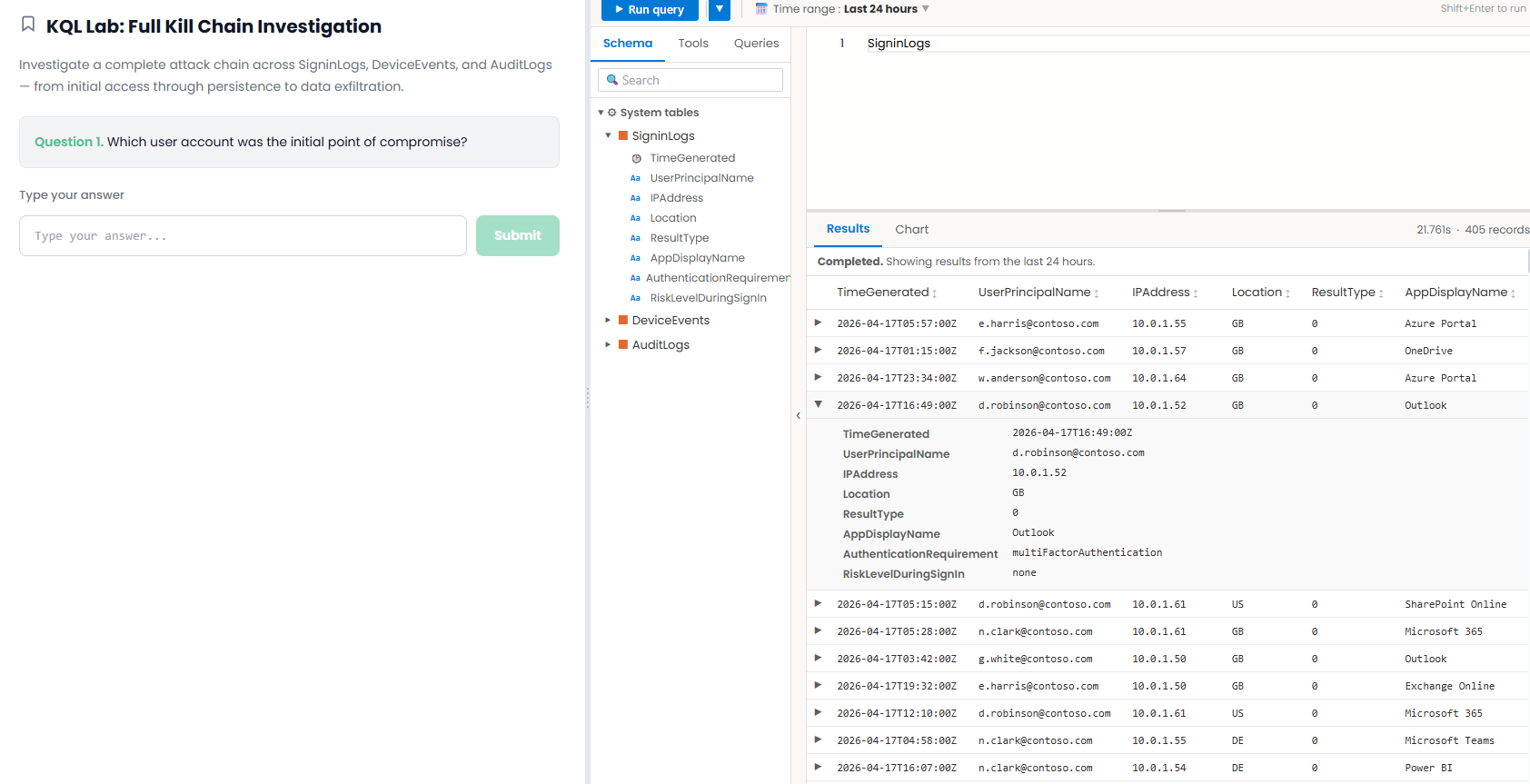
For a SOC assessment, a KQL workspace can show whether the candidate can connect evidence across tables. Inspect the conclusion as well as whether the query runs. Retrieving events is only part of an investigation.
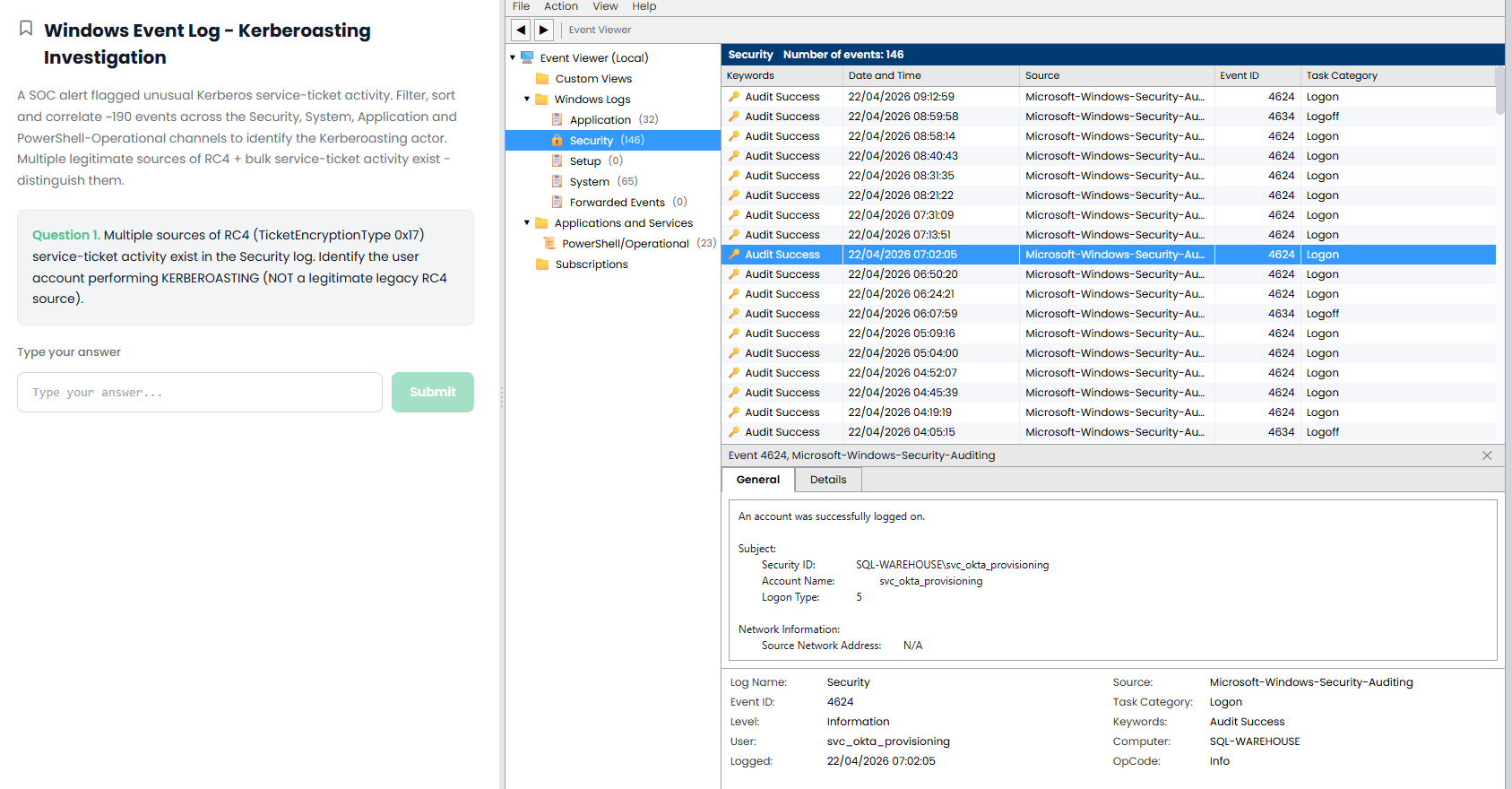
A Windows event log investigation provides another example. Ask the candidate to examine service-ticket activity and explain whether it warrants investigation for Kerberoasting.
MITRE ATT&CK’s Kerberoasting guidance describes indicators including unusual service-ticket requests, RC4 encryption and departures from normal service-account usage. A useful assessment tests whether the candidate can interpret those signals in context. A single event or encryption type should not become an automatic verdict.
Level matters too. A junior analyst may be expected to recognise concerning evidence and escalate with a clear explanation. A senior candidate may need to challenge the initial hypothesis, identify missing evidence and weigh response options.
For the detailed task-design method, see how to assess cyber security skills of candidates.
How should assessment results be scored?
Ask to see a completed sample report before buying. A headline score is useful for navigation, but the hiring team needs to understand what sits behind it.
Look for four things:
- Skill breakdowns: which requirements the candidate demonstrated and where the evidence is weak.
- Actual work: answers, findings or other outputs that you can inspect.
- Scoring criteria: what earns credit and how incomplete or alternative valid answers are handled.
- Interview follow-up: uncertainties worth exploring with the candidate.
Agree essential requirements before reviewing candidates. Otherwise, a strong overall result can hide a gap in the skill you most need.
For example, if secure code review is central to the role, unrelated strengths should not obscure weak code analysis. Conversely, a small syntax error should not automatically outweigh a sound investigation if syntax recall is not the skill being tested.
Pilot the assessment with someone who understands the work. Use that review to catch ambiguous instructions, incorrect answers and unrealistic timing. A pilot is a quality check, not proof that a score predicts performance after hiring.
The fuller buying checklist is in questions to ask a cyber assessment vendor.
How do you assess integrity controls?
Start by defining the rules. Tell candidates whether documentation, search, notes or AI assistance are permitted. The rules should reflect whether you are assessing unaided knowledge or performance with specified resources.
Then ask what the platform records and what the reviewer can inspect. A monitoring feature is useful only if you understand its coverage and limitations.
CyberHire offers Unmonitored, Standard and Proctor modes. Its integrity controls can flag time away, outside pasting, fullscreen exits and second screens. Proctor adds webcam snapshots with consent, and IP address and location are recorded for every candidate.
Those signals need interpretation. Pasting may have an allowed explanation. Leaving the assessment window does not establish what the candidate did elsewhere. Location alone does not prove who completed the task.
Keep integrity review separate from technical scoring. Investigate relevant flags and use a follow-up discussion to explore the candidate’s reasoning. Neither monitoring nor practical tasks make an assessment immune to outside help.
Where should an assessment fit in the interview process?
Before technical interviews
When you have a large applicant pool, use a focused assessment after checking essential eligibility and explaining the process. It gives the hiring team evidence to help decide whom to interview.
Choose tasks that address the minimum technical requirements. Keep the time commitment proportionate and explain what candidates will need before they start.
Alongside interviews for an existing shortlist
If you already have a shortlist, assess the capabilities that remain uncertain. Candidates can complete the task before a technical interview, allowing the interviewer to explore their findings and decisions.
Ask what evidence changed their view, what they would investigate next and what they could not conclude. This makes the interview a review of demonstrated work as well as past experience.
In both workflows, comparable candidates need a consistent standard. Keep the core requirements and scoring criteria aligned, explain permitted resources and provide a route to request adjustments or report technical problems.
What should you check before choosing an assessment platform?
Use the same questions when comparing options. Ask for demonstrations and sample outputs rather than accepting a feature label as the answer.
| Check | What to request |
|---|---|
| Role relevance | A task mapped to an essential requirement in your vacancy |
| Difficulty | An explanation of how expectations change with seniority |
| Candidate experience | A walkthrough of instructions, environment and submission |
| Evidence | A completed report with the underlying candidate work |
| Scoring | Criteria, partial-credit rules and the process for reviewing disputed answers |
| Integrity | The signals captured in each mode and how reviewers interpret them |
| Administration | A demonstration of invitations, results and any ATS connection you need |
| Commercial scope | What the engagement includes and how additional hiring is handled |
Once you know which format you need, the comparison of cybersecurity skills assessment platforms for hiring can help you build a supplier shortlist.
What else do employers ask about cyber hiring assessments?
How long should a cyber hiring assessment take?
There is no single duration that suits every role or hiring stage. Select the smallest set of tasks that answers your hiring question, pilot the timing and tell candidates the expected commitment before they accept.
Can you use the same assessment for different cyber security roles?
You can reuse relevant tasks, but the overall assessment should reflect each role’s responsibilities. Shared security knowledge does not make SOC investigation, cloud configuration review and secure code review interchangeable.
Does a hands-on assessment replace a technical interview?
No. It provides work to discuss and helps focus the interview on reasoning, trade-offs and gaps in the evidence. You still need to assess responsibilities the exercise does not cover.
Can you assess candidates who have already been shortlisted?
Yes. A practical assessment can add consistent technical evidence to an existing shortlist. Use the results alongside interviews and the requirements agreed for the role.
What is a good pass score?
A percentage has little meaning without the task difficulty and scoring criteria. Define the essential capabilities for the role first, review how the assessment measures them and use the underlying evidence when deciding who progresses.
Where CyberHire fits
CyberHire provides cyber technical screening built for exactly this decision. Hiring teams pick a ready-made assessment from a library of 270+ hands-on challenges, or paste a job specification and generate one, then invite candidates by link or straight from their ATS. Candidates work in real environments - KQL workspaces, Windows event logs, Linux terminals, PowerShell, Active Directory, email analysis and code review - rather than answering questions about them.
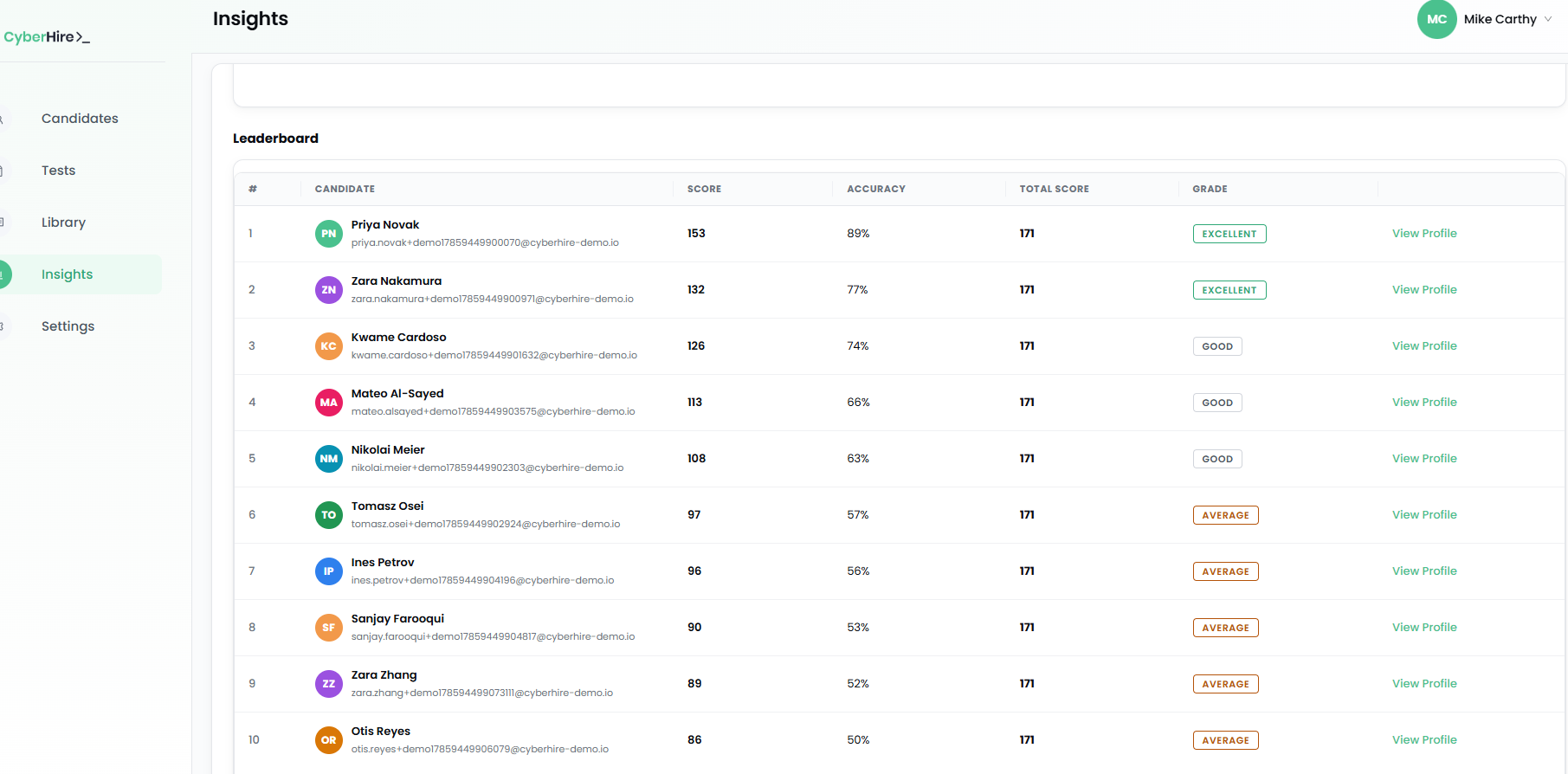
Every candidate is scored on the same criteria. The hiring team sees a ranked cohort, a breakdown by skill, each candidate’s actual answers and their integrity flags, and a hiring intelligence report with what to probe at interview.
It works at either point in the process described above: screening a large applicant pool before technical interviews, or adding evidence to a shortlist you already have. If you would rather not build the assessment yourself, our team will build it with you. The platform supports the decision; the employer makes it.
Choosing an assessment for a live role?
See a role-specific assessment on your vacancy.
Tell us the role you are hiring for. We will show you the hands-on tasks candidates would complete, how their work is scored, and the evidence your team gets back before interview.