For security leadership
Your team pays for every unscreened candidate.
First-round screening lands on the people you can least afford to interrupt, and the consequence of a weak technical hire lands on you. CyberHire puts every candidate through the work, in environments that resemble the job, and shows you the evidence before anyone books an interview.
What it costs you
The bill arrives in analyst hours and in risk.
- 01
Your seniors are doing first-round screening.
The people you most need on operational work are the only ones who can tell whether a candidate can actually do the job. Every hour they spend in a first-round interview is an hour off the queue.
- 02
A wasted interview costs a full hour.
Not fifteen minutes. An hour of a senior analyst's day, spent on someone who was never going to be capable, and it is usually obvious inside the first five minutes.
- 03
A certification proves an exam pass.
It does not tell you whether someone can look at a failed authentication chain and decide whether it is a broken service account or the beginning of lateral movement.
- 04
The gap surfaces months later.
Three to six months of ramp before anyone works unsupervised. By the time you discover the CV was optimistic you have lost half a year, and the team has quietly absorbed the difference.
- 05
A weak hire is a risk, not just a cost.
In most functions an underperformer is a productivity problem. In yours, they are the person who does not escalate the alert that mattered.
- 06
You carry a decision made on two pages.
The document that got them in front of you was written by them, quite possibly with a language model. The consequence of believing it is entirely yours.
Your seniors are screening.
The people you most need on the queue are the only ones who can judge a candidate.
Minutes, not evenings.
Generate the assessment from the job spec, or have our team build it with you.
An hour lost per wasted interview.
And it is obvious inside five minutes that they were never going to be capable.
Only proven candidates reach a calendar.
Everyone your team meets has already demonstrated the work.
Certifications and stated experience.
Proof of an exam pass, not of reading a failed authentication chain correctly.
Work done in the real tools.
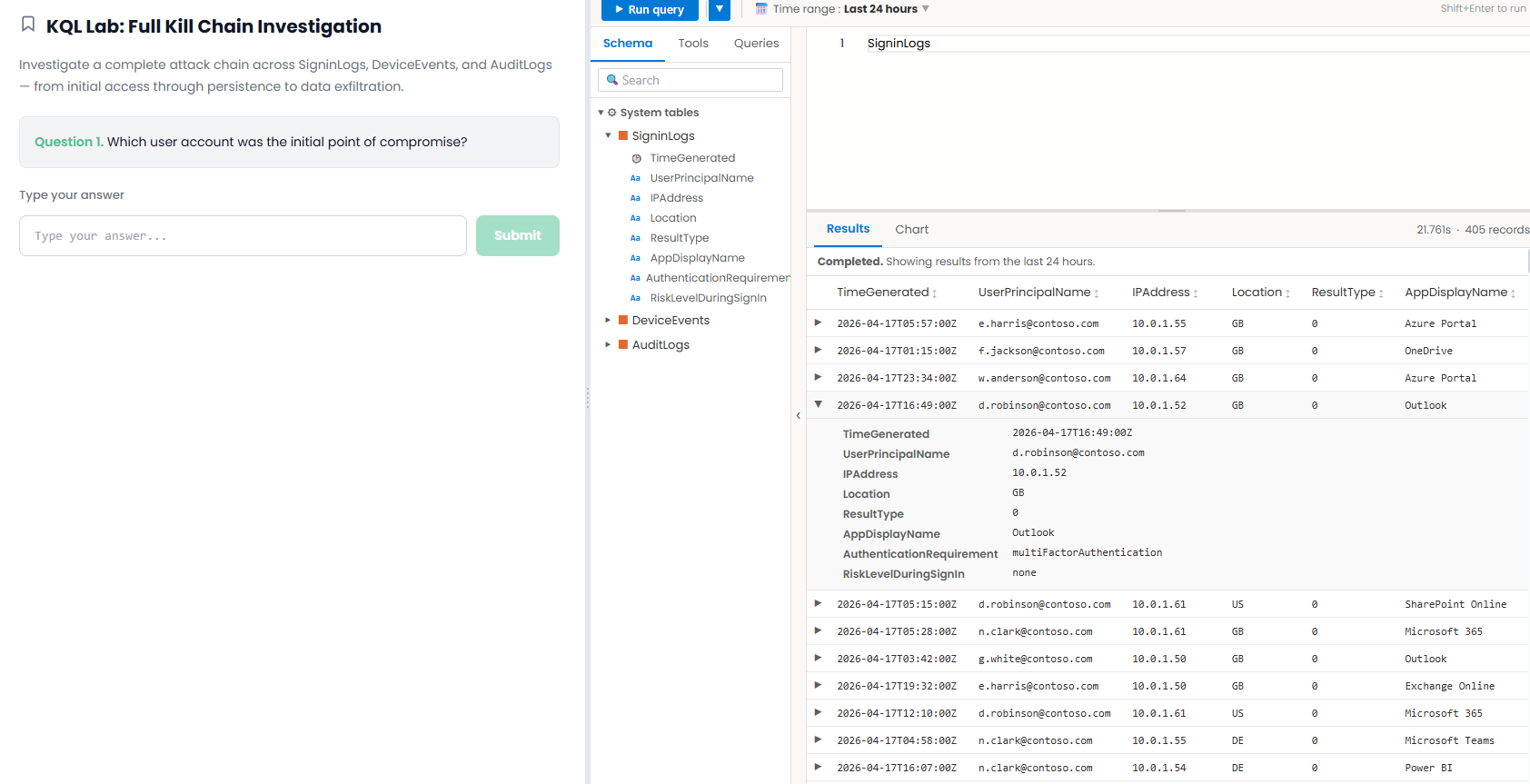
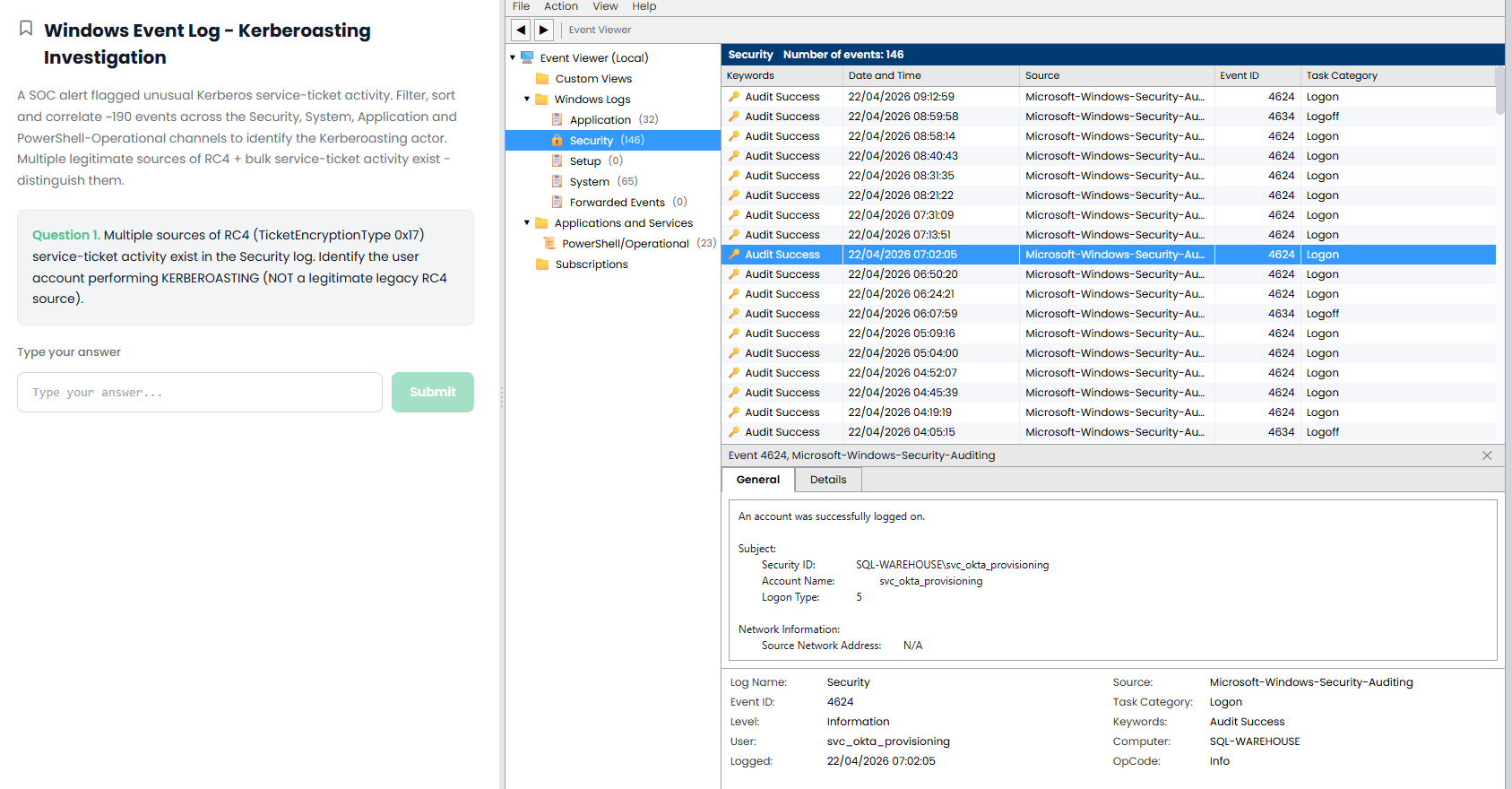
Live shell, KQL against realistic telemetry, actual Windows event logs.
A score you are asked to trust.
Or worse, an impression from an hour in a room with someone rehearsed.
Reasoning you can interrogate.
Per-skill breakdown, the answers underneath, time taken, integrity signals.
Three to six months to find out.
The gap surfaces long after the decision, and the team absorbs the difference.
You find out before the offer.
The evidence arrives while it can still change what you decide.
The risk sits with you.
A weak hire in a security function is not a productivity problem. It is a missed alert.
A decision you can defend.
Comparable evidence for every candidate, on file, for whoever asks later.
What changes
Evidence you can interrogate, before the interview.
-
They do the work, in the actual tools.
A live shell, a Sentinel-grade KQL editor, real Windows event logs, real packet captures. Not multiple-choice questions about frameworks, and not a coding puzzle that has nothing to do with the role.
-
Built for your role, not off a shelf.
Generate the assessment from your job spec at the tier you are hiring at, or have our team build it with you. Either way you review the whole thing, and change it, before it reaches a single candidate.
-
You see the reasoning, not a pass mark.
Score per skill, the candidate's actual answers underneath, time taken, and integrity signals on every attempt. Nothing is a black box you are asked to trust.
Judge it yourself
This is the actual content. Not a description of it.
You are being asked to trust an assessment you did not write, for a role you are accountable for. So here are real cases at full size. If they are not hard enough, or not right for your stack, that is exactly what you change before yours goes out.
Integrity
Technical evidence is worthless if you cannot trust how it was produced.
Some candidates will try to game any assessment. Every attempt is monitored for time away from the test, pasting from outside, fullscreen exits and second screens, every candidate's location is recorded, and Proctor mode adds webcam snapshots with consent. Every signal appears against the candidate in the report. Flags are evidence for you to weigh, not a verdict we reach on your behalf - nobody is removed from your shortlist without you deciding it. No assessment catches everything, and we will not claim otherwise. What it does catch, it catches consistently and shows you.
Tom Okafor
Risk score
41/100
REVIEWIntegrity events
Concentrated in Q3. Largest paste was 184 chars into the free-text answer.
Second display connected at 14:32, 11 minutes into the session.
8 of 12 in the final 5 minutes of the session.
Session IPs from GB and CN. Candidate listed as UK-based.
Passed checks
What this protects
The things you are actually measured on.
- Analyst capacity, returned to operational work
- Interview time spent only on candidates who cleared a technical bar
- Mean time to respond, protected from a capability gap you did not know you hired
- Comparable evidence across every candidate for the role
- A defensible answer when someone asks why this person
- A ranked shortlist that cost your seniors no screening hours
The questions worth asking us.
Will the assessment actually reflect our environment?
It is built from your job spec and your stack. If you run Sentinel, the hunting is KQL against realistic tables; if you run Splunk, there are SPL query challenges. If the role is Linux-heavy, it is a live shell with real log output. If it is detection engineering, they write and tune rules. You review the assessment before it goes out and change anything that is wrong for the role.
Who writes the content?
Security practitioners, not a content team working from a syllabus. The design principle is that decoys matter more than the answer: a challenge with a single anomaly on an otherwise clean page tests reading comprehension. Ours put legitimate activity alongside the malicious kind, because separating the two is the actual job.
How do I know they did not just use AI?
Every attempt is monitored for time away from the test, pasting from outside, fullscreen exits and second screens, and the report tells you which candidates ran clean and which did not. Answers are free text rather than multiple choice on the investigative cases, so there is nothing to guess between. No assessment is uncheatable, and any vendor telling you theirs is should worry you. What we do is make the attempt observable and hand you the signals.
Is this another platform my team has to maintain?
No. The challenge library, the environments and the scoring are built and maintained by us. Building an assessment is pasting the job spec and reviewing what comes back, and results arrive ranked. If you would rather hand it over, our team builds it with you and your involvement is one briefing call about the role.
Will strong candidates refuse to do it?
Strong technical candidates tend to prefer it. It is usually the first stage in a process that lets them demonstrate capability rather than describe it, and people from non-traditional backgrounds get a route that a CV screen never gives them. The candidates who drop out are more often the ones whose CV was doing the work.
What do I actually get back?
A ranked shortlist, and a profile for each shortlisted candidate: score by skill, where they were strongest, where the score is thinner, what to probe in the interview, and a written recommendation. It reads in two minutes and forwards to anyone, including people who will never log in.
Ready when you are