Incident response hiring
Hire incident responders who make the right call under pressure.
Put candidates in the first hour of a real incident - a ransomware outbreak, a CFO wire request, a malicious script on a host - and see what they contain, what they preserve and what they work out. Build the assessment from your job spec, or have our team build it with you.
Why this hurts
Incident response skill rarely shows in an interview.
- 01
Knowing the playbook is not running it.
Most candidates can recite the phases of incident response. Choosing what to contain first when every option has a cost is a different skill, and it is the one you are hiring for.
- 02
Evidence handling is easy to get wrong.
A responder who breaks the chain of custody or overwrites the artefact that mattered can undo the whole investigation. A CV will not tell you who is careful.
- 03
Reconstruction needs hands on the data.
Working out what an attacker did means reading registry keys, scripts and logs. Talking about it is not the same as doing it.
How we fix it
Test the decisions, the evidence and the investigation.
-
Containment decisions under pressure.
Realistic first-hour scenarios ask candidates what to do and in what order, so you see their judgement when every option has a trade-off.
-
Forensics in real environments.
Candidates work registry artefacts, PowerShell activity and email evidence directly, and reconstruct what happened from what is in front of them.
-
Evidence handling checked.
Chain-of-custody review shows who handles evidence properly before it matters on a real incident.
What you can actually test for
Incident response challenges from the library.
- Ransomware: hour-one containment decisions
- BEC response: the first 30 minutes of a CFO wire request
- Chain of custody log: forensic evidence review
- Email analysis: payroll diversion targeting HR
- Registry forensics: persistence via Run keys, scheduled tasks and IFEO
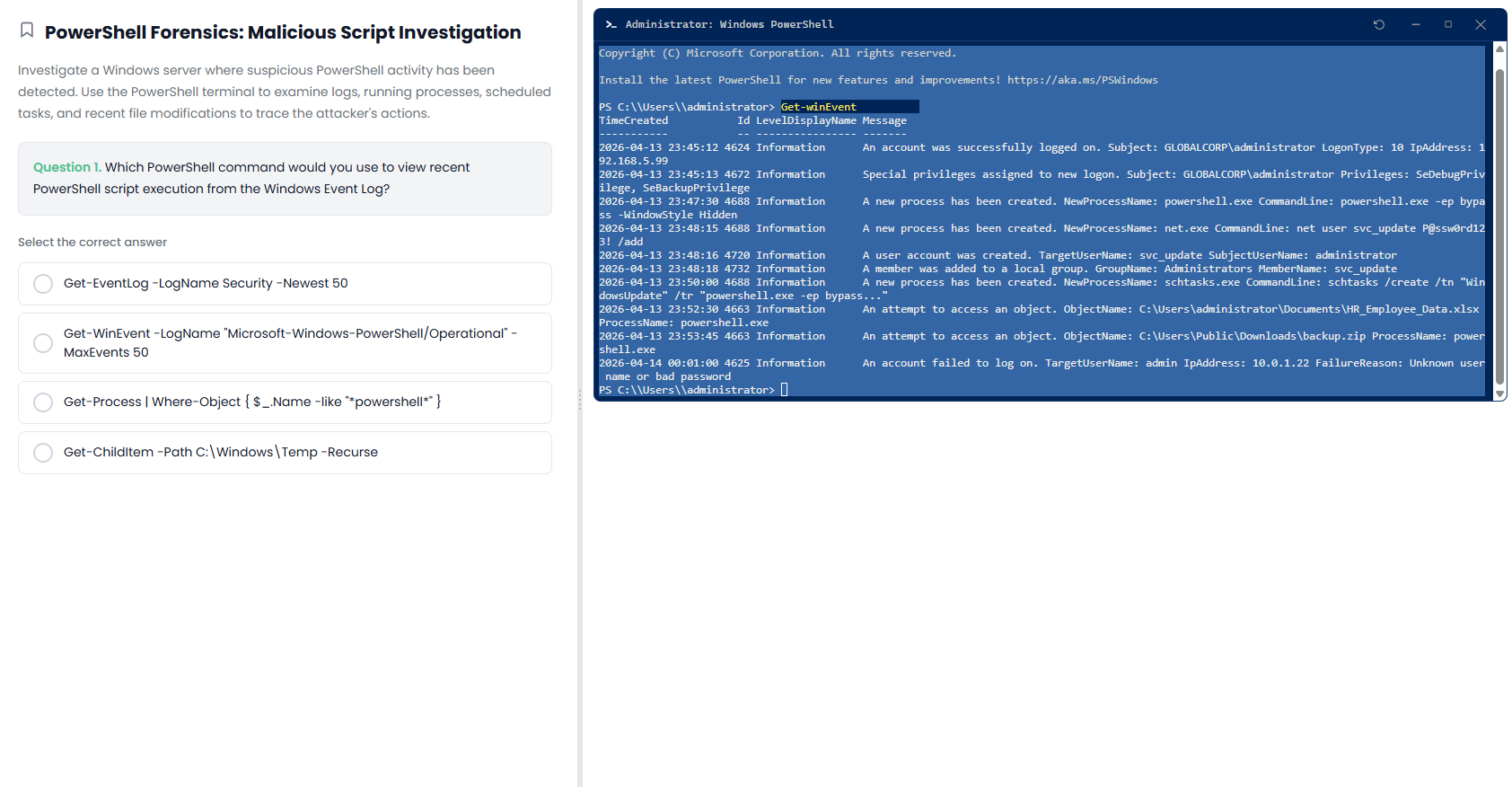
- PowerShell forensics: malicious script investigation
Honest comparison
Incident response hiring with CyberHire vs the usual.
| CyberHire | CV screen + scenario interview | |
|---|---|---|
| Tests containment judgement | Realistic first-hour decisions | Hypothetical discussion |
| Tests forensic investigation | Hands-on with registry, PowerShell and email evidence | Described, not demonstrated |
| Who builds the assessment | Generated from your job spec, or built with our team | Your senior responders |
| Consistency across candidates | Same scenarios, same scoring | Varies by interviewer |
| Integrity controls | Three integrity modes, flagged next to every score | Generic or none |
What an incident response candidate actually works on
Not a quiz about the incident response lifecycle. The evidence, in the tools, with the decisions left to the candidate.
Incident response hiring questions
How do you assess an incident responder before interview?
Put them in a realistic incident: ask for containment decisions in the first hour, have them review evidence handling, and give them forensic artefacts to reconstruct what the attacker did. Score their decisions and findings, then explore their reasoning at interview.
Can you assess different levels of responder?
Yes. Build the assessment to the level you are hiring at. A junior responder may be expected to recognise evidence and escalate clearly; a senior one should make and justify containment decisions and lead the reconstruction.
Do we still need to interview?
Yes. The assessment shows who can do the work. The interview can then focus on communication during an incident, working with stakeholders and the areas the assessment flagged.
Stop guessing.