How to Assess Cloud Security Skills Before You Hire
How to assess cloud security skills across AWS, Azure and GCP: four skills, a task for each, what strong and weak attempts look like, and how to calibrate.
 6 min read
To assess cloud security skills, test four things: reading identities and permissions, spotting misconfiguration and exposure, investigating cloud logs, and securing infrastructure as code. Use the clouds the person will actually work in, give them real policies, logs and templates, and score what they find and how they would fix it. Certifications show study of a provider’s services; they do not show whether someone can spot the one permission that turns a reader into an administrator.
Below, each skill comes with what it looks like on the job, a task that tests it, and what strong and weak attempts look like.
1. Reading identities and permissions
On the job: most cloud breaches start with an identity that has more access than it needs. The engineer has to read policies and role assignments and see what they really allow.
A task that tests it: give the candidate an AWS IAM policy, or a list of Azure role assignments, and ask what the identity can do and what they would change.
| A strong attempt | A weak attempt |
|---|---|
| Spots wildcard actions and resources | Reads the policy line by line without seeing the whole |
| Finds permissions that allow privilege escalation, such as passing a role to new compute | Misses indirect paths to more access |
| Rewrites it to the minimum the workload needs | Says “tighten it” without saying how |
2. Spotting misconfiguration and exposure
On the job: storage buckets made public, databases reachable from the internet, management ports left open. The engineer has to find what is exposed and fix the root cause, not just the instance.
A task that tests it: give the candidate a bucket policy and a network diagram for a cloud application and ask what is exposed and to whom.
| A strong attempt | A weak attempt |
|---|---|
| Identifies public access and checks whether account-level controls override it | Assumes resources are private by default |
| Spots databases with a route to the internet and missing outbound controls | Focuses only on inbound rules |
| Proposes guardrails so it cannot happen again | Fixes the one resource and moves on |
3. Investigating cloud logs
On the job: when credentials leak or something unexpected appears in an account, the engineer has to read the audit logs and work out what happened, knowing which logs exist and which were never switched on.
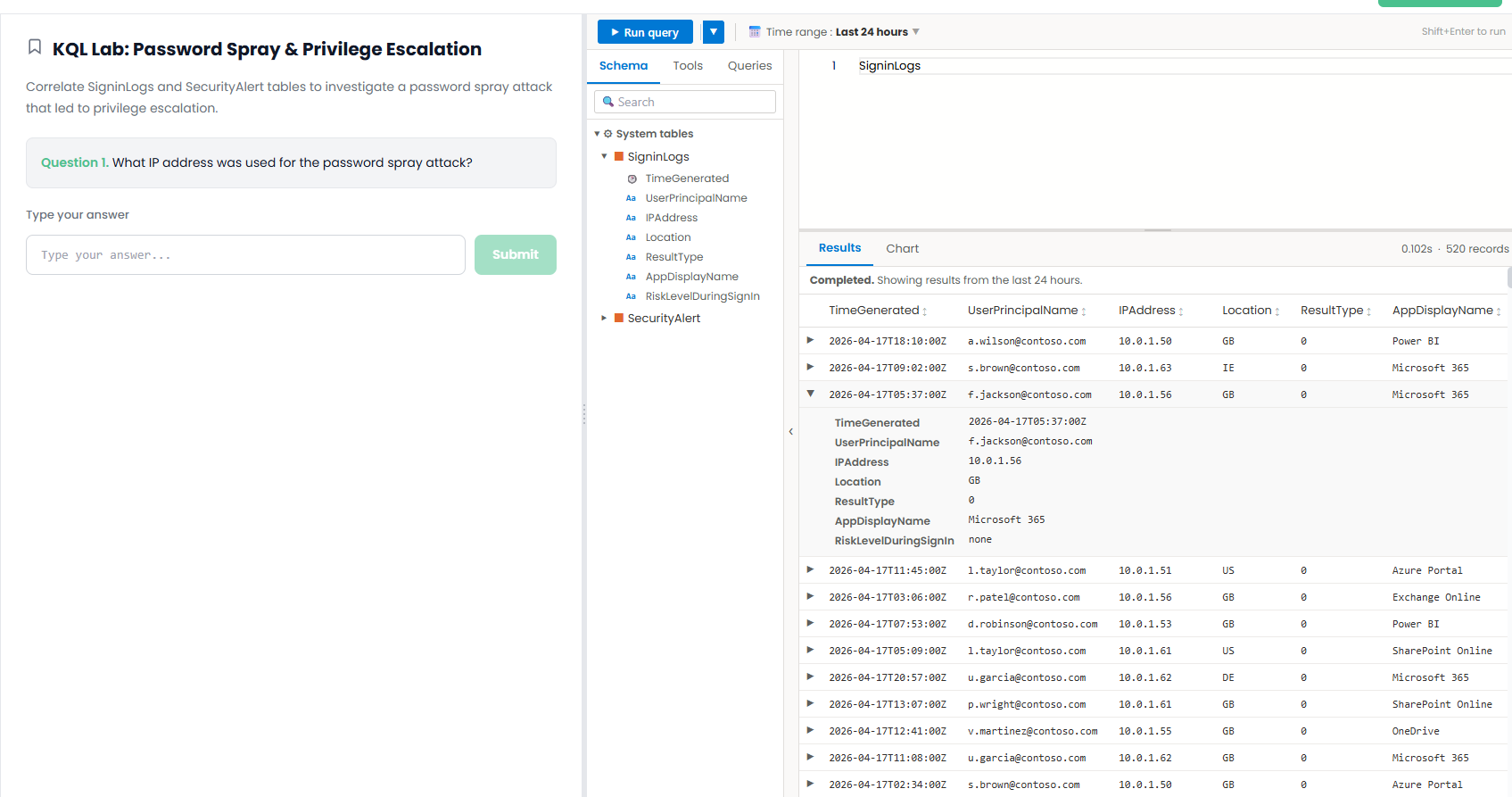
A task that tests it: give the candidate 20 CloudTrail events, or Entra ID sign-in logs, and ask what happened.
| A strong attempt | A weak attempt |
|---|---|
| Builds the sequence: a new login, a new key, admin rights, then activity in a new region | Lists events without connecting them |
| Knows which events are not logged by default, such as S3 data events | Assumes the logs show everything |
| Moves straight to containment: revoke sessions, rotate keys | Keeps investigating while the attacker is still active |
4. Securing infrastructure as code
On the job: most cloud resources are created from templates such as Terraform. Fixing a problem in the console is temporary; fixing it in the code that created it is permanent.
A task that tests it: give the candidate a Terraform plan with security issues and ask them to find and fix them.
| A strong attempt | A weak attempt |
|---|---|
| Finds SSH or RDP open to the internet, unencrypted storage and broad roles | Finds one issue and stops |
| Fixes the code, not the deployed resource | Suggests changing it by hand in the console |
| Suggests pipeline checks to catch it next time | Treats it as a one-off |
Breadth across clouds or depth in one?
Test the clouds you run, at the depth the role needs. AWS, Azure and GCP each have their own identity model and logging, and strength in one does not guarantee strength in another. If the role is AWS-first, weight the assessment to AWS. If it genuinely spans several clouds, test each one rather than assuming skills transfer, because a candidate who presents as multi-cloud but only knows one is a common and costly surprise.
How to calibrate the assessment by level
| Level | What they own | What to test |
|---|---|---|
| Junior | Reviewing findings, fixing misconfigurations | Reading policies, spotting exposure |
| Mid-level | Securing accounts and investigating issues | Permissions, cloud logs, infrastructure as code |
| Senior or lead | Guardrails and design across many accounts | Multi-account governance, architecture trade-offs, pipelines |
What an assessment cannot tell you
A hands-on assessment shows whether a candidate can read policies, logs and code in your clouds. It cannot fully show how they design security for a large organisation, how they persuade engineering teams to adopt guardrails, or how they balance security against delivery speed. Leave those for the interview and references.
For questions to use in that interview, see these cloud security interview questions. For the wider method behind task design and scoring, see how to assess cyber security skills of candidates.
Frequently asked questions
What skills does a cloud security engineer need?
Identity and permission design, network and storage configuration, cloud logging and detection, infrastructure as code, and an understanding of how attackers abuse cloud services, on the providers the organisation actually uses.
Are cloud certifications a good way to assess candidates?
They show a candidate has studied a provider’s services, which is useful. They do not show whether the candidate can find a real misconfiguration or read a real policy under time pressure, which is what a hands-on task tests.
How do you test cloud security skills without giving candidates access to your cloud?
Use prepared material: policies, logs, templates and diagrams built from demo data, or a purpose-built assessment environment. Candidates never need access to your real accounts.
How CyberHire assesses cloud security engineers
CyberHire is cyber technical screening that tests these skills on the clouds you run. Paste a job specification that says AWS-first and you get an AWS-weighted assessment; say multi-cloud and it tests each cloud. Candidates work on IAM policy review across AWS, Azure and GCP, storage misconfiguration hunts, cloud audit log analysis and privilege escalation paths.
Every candidate is scored the same way, with integrity signals next to each score. See how it works for cloud security hiring. If you would rather not build the assessment yourself, our team will build it with you.
Hiring a cloud security engineer?
Test cloud security skills on the clouds you run, free.
Send us the job spec. Within 48 hours we send you a hands-on assessment built around it, in your branding, weighted to your clouds. See who can read an IAM policy before you interview anyone.