
How to Assess Incident Response Skills Before You Hire
How to assess incident response skills: the four skills that matter, a task for each, what strong and weak attempts look like, and how to calibrate by level.
 6 min read
To assess incident response skills, test four things: scoping an incident from incomplete evidence, making containment decisions under pressure, handling evidence properly, and communicating clearly while it is happening. Give the candidate real evidence and a decision to make for each, and score what they do first, what they check before acting, and how they explain it. Knowing the incident response lifecycle by heart is the least useful thing you can test.
Below, each skill comes with what it looks like on the job, a task that tests it, and what strong and weak attempts look like.
1. Scoping an incident from incomplete evidence
On the job: an alert fires, and the responder has to work out what actually happened, how far it has spread and what the attacker can reach, before anyone has the full picture.
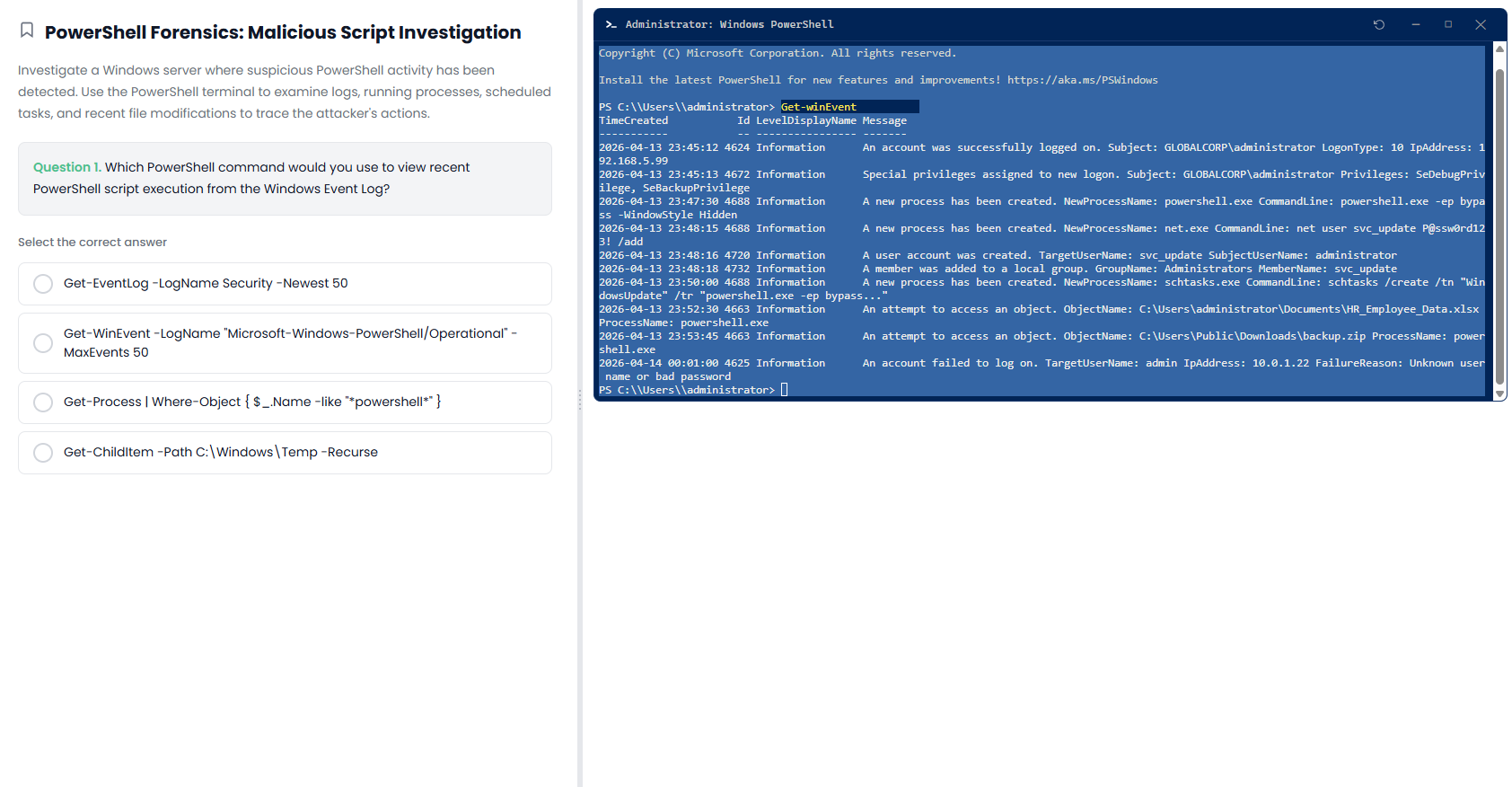
A task that tests it: give the candidate an event log export or a set of alerts from several machines and ask what happened, in what order, and what else they would check.
| A strong attempt | A weak attempt |
|---|---|
| Builds a timeline, normalising time zones first | Focuses on the first suspicious event and stops |
| Separates what is known from what is assumed | States conclusions the evidence does not support |
| Lists the next things to check, in priority order | Has no plan beyond the evidence in front of them |
| Looks for what the attacker did next, not just the first step | Treats the alert as the whole incident |
2. Containment decisions under pressure
On the job: the responder has to stop the damage without destroying evidence, tipping off the attacker or taking down the business. Every option has a cost.
A task that tests it: describe hour one of a ransomware incident, with machines encrypting and the business asking what to do, and ask for the first five decisions and why.
| A strong attempt | A weak attempt |
|---|---|
| Isolates affected systems without powering them off | Pulls the plug, losing memory evidence |
| Protects and checks backups early | Forgets the backups until it is too late |
| Moves communication to a separate channel | Coordinates over email that may be compromised |
| Brings in leadership, legal and the insurer early | Tries to handle it alone |
| Explains the trade-off behind each decision | Gives a list of actions with no reasoning |
3. Handling evidence properly
On the job: if an incident might lead to legal action, an employment case or a regulator’s questions, how the evidence was collected and handled decides whether it can be used.
A task that tests it: give the candidate a chain of custody form for a seized laptop, with gaps in it, and ask what is wrong and why it matters.
| A strong attempt | A weak attempt |
|---|---|
| Spots unrecorded transfers, missing hashes and missing signatures | Reads the form and says it looks fine |
| Explains how each gap could make the evidence unusable | Cannot say why the details matter |
| Knows to capture the most volatile evidence first | Images the disk and ignores memory |
4. Communicating while it is happening
On the job: executives want answers, legal needs facts, and the technical team needs clear direction, often all at once and with incomplete information.
A task that tests it: ask the candidate to write the first update for the leadership team in five sentences, based on the evidence from task 1.
| A strong attempt | A weak attempt |
|---|---|
| Says what is known, the impact, what is being done and when the next update comes | Pads it with jargon or speculation |
| Separates facts from assumptions | Presents guesses as facts |
| Says what decision is needed from the reader | Leaves the reader unsure what to do |
How to calibrate the assessment by level
The same task can be too hard for one level and too easy for another. Match the depth to what the person will own.
| Level | What they own | What to test |
|---|---|---|
| Junior | Supporting investigations, collecting evidence | Reading logs, building a timeline, evidence handling basics |
| Mid-level | Running investigations and containment | Scoping, containment trade-offs, persistence hunting |
| Senior or lead | Leading the response and the people around it | Decisions under pressure, communication, legal and regulatory awareness |
What an assessment cannot tell you
A hands-on assessment shows how a candidate reads evidence and makes decisions. It cannot fully show how they behave in a real incident at 3am after 14 hours, how they lead a team under stress, or how they handle a frightened executive. Leave those for the interview, using scenarios and their own past incidents, and for references.
For questions to use in that interview, see these incident response interview questions. For the wider method behind task design and scoring, see how to assess cyber security skills of candidates.
Frequently asked questions
What skills does an incident responder need?
Scoping incidents from incomplete evidence, sound containment decisions, careful evidence handling and clear communication under pressure, backed by technical knowledge of forensics, logs and attacker techniques.
How do you test incident response skills in an interview?
Use scenarios with real evidence: a log to read, a decision to make, an update to write. Ask what they would do first and why. Scenarios reveal judgement in a way that questions about frameworks cannot.
Should an incident response assessment be timed?
Yes, within reason. Incident response happens under time pressure, so a time limit is realistic, but it should allow a thoughtful answer. The aim is to see good decisions made quickly, not to reward rushing.
How CyberHire assesses incident responders
CyberHire is cyber technical screening that tests these four skills before you book an interview. Pick the ready-made incident response assessment or paste your job specification and generate one. Candidates work through hour-one ransomware containment decisions, the first 30 minutes of a fraudulent CFO wire request, chain of custody review, registry and PowerShell forensics, and a payroll diversion email.
Every candidate is scored the same way, with integrity signals next to each score, and you see their reasoning. See the challenges in the incident response skills test, or how it works for incident response hiring. If you would rather not build the assessment yourself, our team will build it with you.
Hiring an incident responder?
Test incident response skills on real evidence, free.
Send us the job spec. Within 48 hours we send you a hands-on incident response assessment built around it, in your branding. See who makes the right call before you interview anyone.