
How to Hire a Cyber Security Analyst (Step by Step)
How to hire a cyber security analyst: define the work, write an advert for it, test before you shortlist, and interview to confirm what the test showed.
 7 min read
To hire a cyber security analyst, define the work the person will actually do, write an advert around that work, test candidates with a short hands-on task before you shortlist, interview to confirm what the test showed, then decide against criteria you set at the start. Most analyst hires that go wrong go wrong at screening, not sourcing: the CV sift picks the best-written CV, not the best analyst.
This guide walks through each step, with the mistakes that cost teams the most.
What does a cyber security analyst do day to day?
The title covers several jobs, so start by being clear which one you are hiring for. In most organisations a cyber security analyst:
- Monitors and triages alerts from tools such as a SIEM and endpoint detection, deciding which matter.
- Investigates suspicious activity, reading logs from endpoints, email, identity and cloud services.
- Escalates and documents, writing up what happened clearly enough for someone else to act on.
- Improves detections and processes, feeding back what was noisy, what was missed and what should be automated.
In a security operations centre the role is often split into tiers: Tier 1 works the alert queue, Tier 2 investigates in depth, and Tier 3 hunts and tunes detections. In a smaller team, one analyst may do all of it, plus vulnerability management and awareness training. Write down which version you need before you write anything else.
Step 1: Define the role around the work, not the certifications
List the three to five tasks the person must handle in their first three months. Be specific: “triage phishing reports and investigate suspicious sign-ins in Microsoft Sentinel” is useful; “monitor security” is not.
Then sort the requirements into two groups:
| Must have on day one | Can be learned in the job |
|---|---|
| Reading logs and spotting what does not belong | Your specific SIEM and its query language |
| Knowing when and how to escalate | Your internal processes and playbooks |
| Clear written communication | Your network, applications and business context |
| Core knowledge of common attacks | Specific tools beyond the core |
Anything in the right-hand column should not be a reason to reject a candidate. Certifications usually belong there too: they show study, not the ability to investigate an alert.
Step 2: Write a job description that attracts people who can do the work
Strong analysts read an advert and ask one question: is this a real job doing real security work? Answer it.
- Lead with the work. Describe a normal week: the alerts, the tools, the investigations, who they work with.
- Keep requirements honest. Every extra “essential” requirement removes good candidates, especially career changers and people from smaller teams.
- Say how you will assess. “Our process starts with a short, practical task” tells strong candidates you will judge them on ability, and puts off people relying on their CV.
- Name the level. Tier 1, Tier 2 or senior, and what the person will own.
Step 3: Test before you shortlist
The CV sift is the weakest step in most analyst hires. Every CV now reads well, many are written with AI help, and keywords and certifications tell you little about whether someone can investigate an alert. Reading 200 CVs to pick 10 interviews is slow, and it still picks the wrong 10.
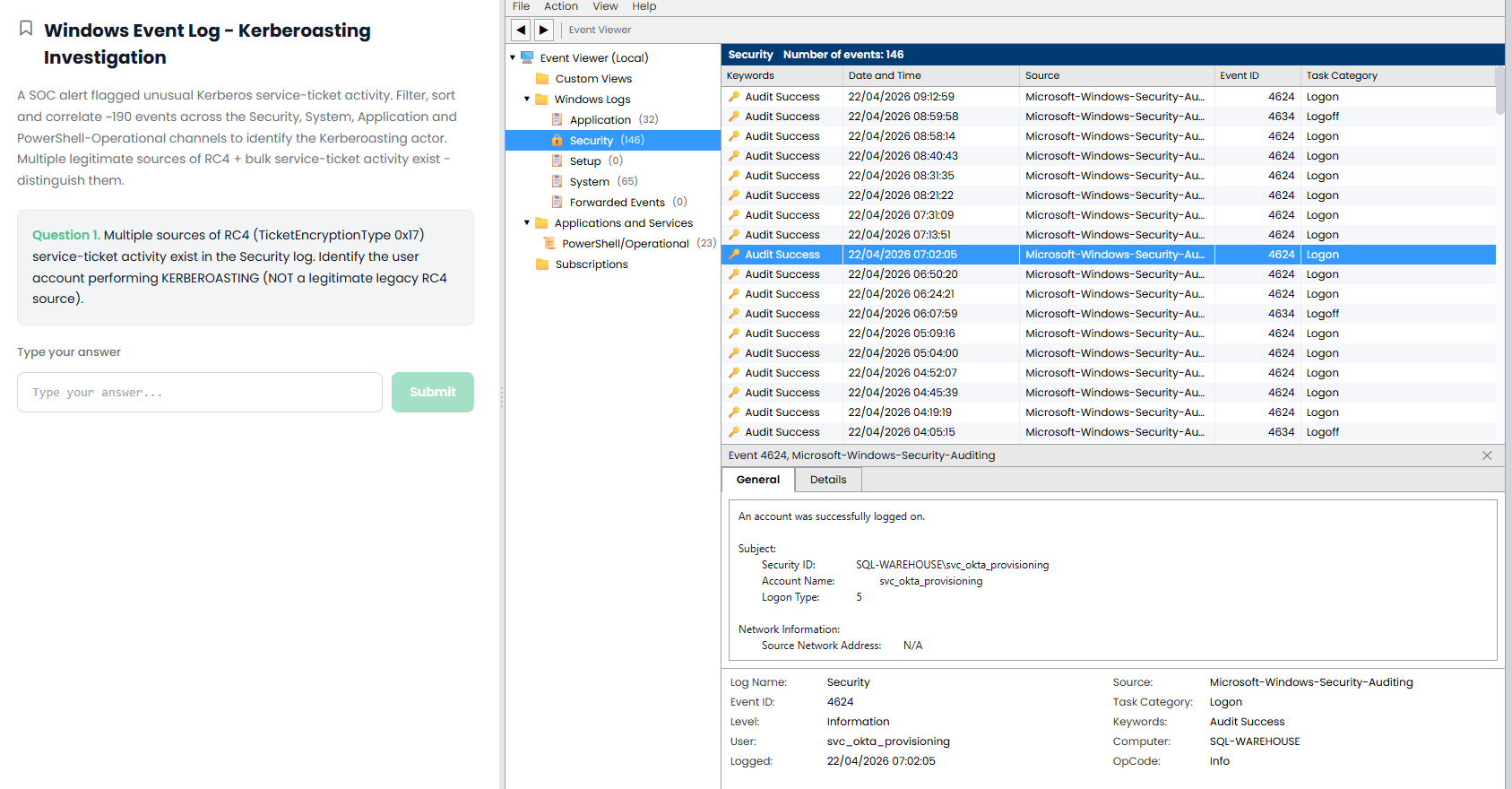
Reverse the order. Send everyone who meets the genuine minimum requirements a short, hands-on task, and shortlist from the results. Keep it focused on the two or three skills the role cannot do without, and score every candidate the same way. The method is set out in how to screen 200 cyber applicants.
Step 4: Interview to confirm the evidence
With test results in hand, the interview has a different job. You are no longer finding out whether the candidate can read a log; you know. Use the time for what a test cannot show:
- Their reasoning. Walk through their test answers: what they checked, what they ruled out, what they would do next.
- Escalation judgement. When would they wake someone at 2am, and when would they keep investigating?
- Communication. Ask them to explain a finding to a non-technical manager.
- The gaps the test found. Probe any weak area directly.
Ask every candidate the same questions in the same order, and agree what a strong answer looks like beforehand. For question sets with strong answers, see these SOC analyst interview questions and the wider list of cyber security interview questions.
Step 5: Decide, and move quickly
Score each candidate against the criteria from Step 1, using both the test results and the interview. Decide as a panel, with the evidence on the table rather than impressions. Then move fast: strong analysts are rarely on the market for long, and a slow process loses them to the company that decided first.
What are the most common mistakes when hiring a cyber security analyst?
| Mistake | Why it hurts | What to do instead |
|---|---|---|
| Shortlisting on CVs and certifications | Picks the best-written CV, not the best analyst | Test a practical skill before shortlisting |
| A long list of “essential” requirements | Puts off strong candidates who do not tick every box | Separate must-haves from what can be learned |
| Interviews that ask for definitions | Rewards rehearsal, not ability | Ask scenarios and review real work |
| A different conversation with every candidate | You compare impressions, not evidence | Same questions, same scoring, agreed in advance |
| Testing at the wrong level | A Tier 3 test makes every Tier 1 candidate look weak | Calibrate the task to the level you are hiring |
| A slow decision | The best candidates accept other offers | Set the decision date before the first interview |
Frequently asked questions
What qualifications should a cyber security analyst have?
The most important qualification is the ability to do the work: reading logs, investigating alerts and explaining what happened. Degrees and certifications can show useful knowledge, but they are not a reliable sign of that ability, so test it directly rather than filtering on paper.
Should I require certifications for a cyber security analyst?
Treat them as a plus, not a requirement. Making certifications essential removes capable candidates, including career changers, and does not guarantee the people who hold them can investigate an alert.
How do I test a cyber security analyst before interviewing them?
Give them a short task from the real job, such as investigating suspicious sign-ins, triaging a phishing email or reading Windows event logs, and score every candidate against the same answers. Keep it short for early screening and save depth for later stages.
What is the difference between a cyber security analyst and a SOC analyst?
A SOC analyst works in a security operations centre, usually focused on monitoring and responding to alerts. “Cyber security analyst” is a broader title that can include SOC work as well as vulnerability management, risk and awareness, depending on the organisation.
How CyberHire helps you hire a cyber security analyst
CyberHire is cyber technical screening built for Step 3. Pick a ready-made analyst assessment or paste your job specification and generate one, calibrated to the level you are hiring. Candidates work in real environments, such as KQL hunting in a Sentinel-style workspace, Windows event logs, phishing emails with full headers and raw logs in a live shell, and are scored the same way, with integrity signals next to every score.
You shortlist from evidence, then interview with sharper questions. Browse the cyber security skills tests, or see how it works for SOC analyst hiring. If you would rather not build the assessment yourself, our team will build it with you.
Hiring a cyber security analyst?
Test before you shortlist, starting this week.
Send us the job spec. Within 48 hours we send you a hands-on assessment built around it, in your branding, free. See who can do the work before anyone books an interview.