Cyber Security Aptitude Test vs Skills Test for Hiring
What a cyber security aptitude test measures, how it differs from a skills test, and when to use each for apprentices, career changers and experienced hires.
 7 min read
A cyber security aptitude test measures whether someone has the potential to learn security work: how they reason, spot patterns and solve unfamiliar problems. A skills test measures whether they can already do the work. They answer different questions, and using the wrong one is a common reason junior hiring goes wrong in one direction and experienced hiring in the other.
The short version: use an aptitude test when you are hiring for potential and nobody is expected to arrive with the skills, such as apprenticeships, graduate schemes and career-changer programmes. Use a hands-on skills test when the person needs to be productive in their first months. For junior roles, a short hands-on task pitched at junior level often tells you more than either, because it shows how someone reasons on real evidence rather than abstract puzzles.
What is a cyber security aptitude test?
An aptitude test checks the underlying abilities that make someone likely to succeed in security work, without assuming any security knowledge. Typical elements include:
- Logical reasoning: following rules and working out what must be true.
- Pattern recognition: spotting the sequence, the anomaly or the item that does not belong.
- Attention to detail: noticing small differences in data that most people skim past.
- Problem solving: working through an unfamiliar task with no worked example.
- Basic technical reasoning: sometimes simple logic or encoding puzzles, still with no prior cyber knowledge needed.
They are usually timed, scored automatically and the same for every role. That makes them cheap to run at volume, and fair to people from non-technical backgrounds who have never touched a SIEM.
Aptitude test vs skills test: the difference
| Aptitude test | Hands-on skills test | |
|---|---|---|
| Measures | Potential to learn the work | Ability to do the work now |
| Prior cyber knowledge | None needed | The skills the role needs |
| Format | Abstract puzzles, reasoning and pattern tasks | Real tasks in realistic environments, such as logs, alerts, code and configuration |
| Best for | Apprentices, graduates, career changers | Anyone expected to be productive in their first months |
| The result tells you | Who is likely to learn quickly | Who can already do the job, and where their gaps are |
| Main risk | A high scorer may still be a long way from useful | Pitched too hard, it screens out juniors with real potential |
The two are not competitors. An aptitude score says nothing about whether someone can triage an alert today, and a skills score says little about how fast a complete beginner will learn.
When an aptitude test is the right tool
Aptitude testing earns its place when you are deliberately hiring people who do not have the skills yet:
- Apprenticeships and graduate schemes, where you plan to train everyone from the basics.
- Career-changer and reskilling programmes, where candidates come from unrelated fields and a skills test would only measure who happened to study in their spare time.
- Large entry-level intakes, where you need a consistent first filter across hundreds of applicants with no relevant experience.
In each case you are betting on how quickly someone will learn, and you have committed to teaching them. Measuring potential is the honest thing to do.
When an aptitude test is the wrong tool
Problems start when aptitude scores stand in for skills:
- Experienced hires. If the job advert asks for someone who can investigate incidents or review code, an abstract reasoning score cannot tell you whether they can. Plenty of strong practitioners score unremarkably on timed puzzles, and plenty of excellent puzzle-solvers have never read a log.
- Any role that needs to be productive quickly. A SOC analyst joining a busy team, or a cloud security engineer joining mid-migration, has no runway for months of training.
- Roles where judgement is the job. Deciding whether an alert is a real attack, or whether a vendor’s control is adequate, depends on knowledge applied to evidence. Aptitude tests deliberately leave knowledge out.
If you are hiring for skills, test the skills. Our guide to pre-employment cyber security tests covers the formats, and where multiple choice falls short.
The middle ground for junior roles
For junior roles that are not formal training schemes, such as a Tier 1 SOC analyst, there is often a better option than either: a short hands-on task pitched at junior level.
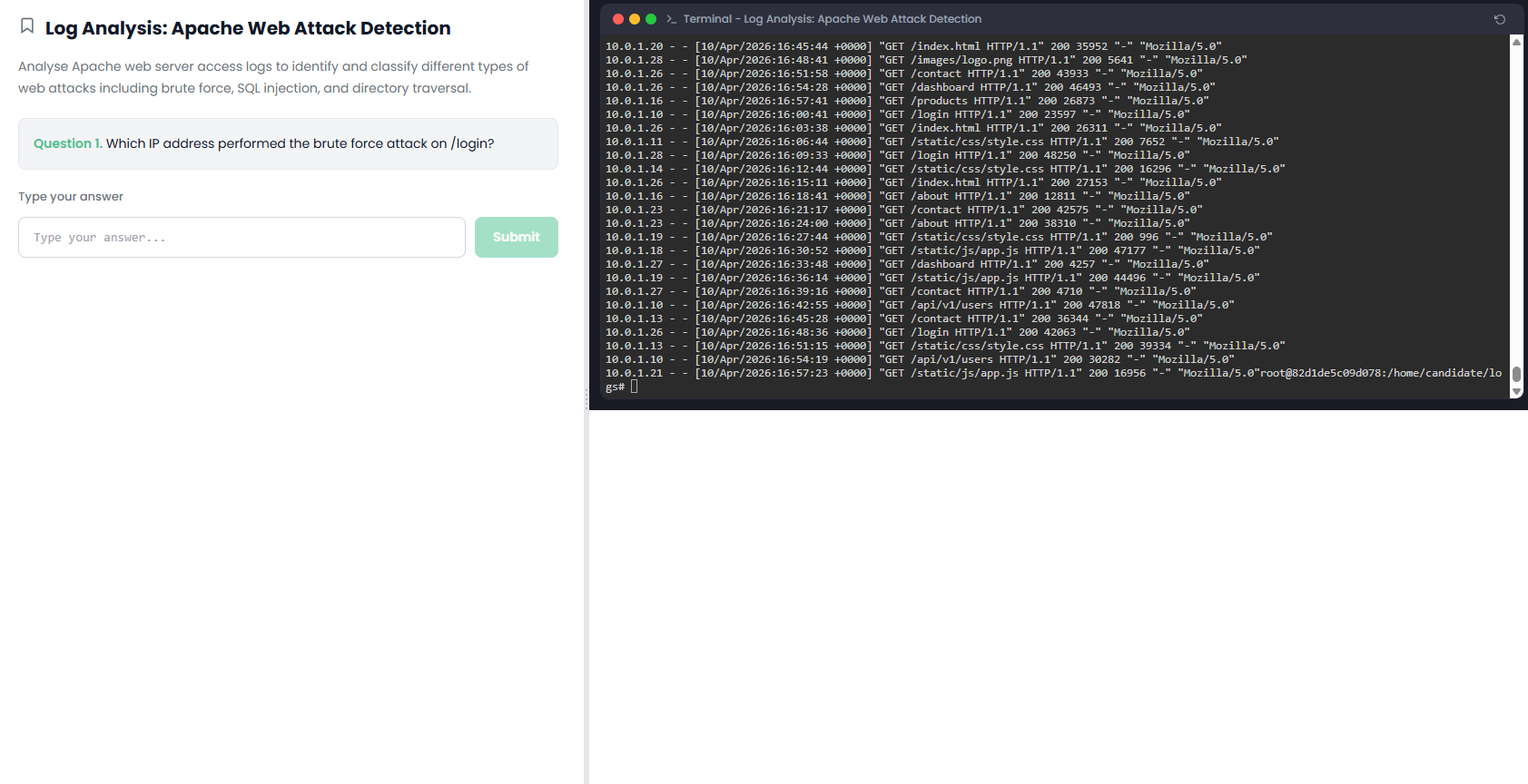
Give a junior candidate a small, realistic piece of the job, such as a set of web server logs with one source brute forcing a login page among normal traffic, and ask them what is happening. It needs only basic knowledge, but it shows the things aptitude tests try to measure, in context:
- Do they have a method, or do they scroll and hope?
- Do they notice what is unusual among legitimate activity?
- Do they reach a conclusion and explain it, or stop at “something looks off”?
That is pattern recognition, attention to detail and problem solving, measured on the material they will actually work with. The key is calibration. A test written by your most senior analyst will be pitched at their level, and every junior candidate will look weak. Our guide to assessing SOC analysts covers how to set the bar for each tier.
What to check before you buy an aptitude test
If an aptitude test is the right tool for your programme, check:
- Evidence that it predicts performance in security roles, not just general job performance.
- Fairness. Timed abstract puzzles can disadvantage some neurodivergent candidates. Ask how the test handles reasonable adjustments such as extra time.
- Relevance. Questions that look nothing like security work make strong candidates wonder about the employer.
- What happens next. An aptitude score should open a door to training or a next stage, not be the only evidence you hire on.
Frequently asked questions
What is a cyber security aptitude test?
It is a test of the abilities that suggest someone could learn security work, such as logical reasoning, pattern recognition, attention to detail and problem solving. It does not assume any prior cyber security knowledge, which is why it is used for apprenticeships, graduate schemes and career changers.
Is an aptitude test the same as a skills test?
No. An aptitude test measures potential to learn. A skills test measures whether someone can already do the job, for example by investigating logs or reviewing code in a realistic environment. Use aptitude tests to hire for potential and skills tests to hire for ability.
Do you need experience to pass a cyber security aptitude test?
No. Aptitude tests are designed for people without security experience. A hands-on skills test is different: it assumes the knowledge the role needs, at the level you are hiring.
Should experienced cyber security candidates take an aptitude test?
Usually not. For experienced hires, an aptitude score adds little to what a hands-on skills test shows, and asking senior people to sit abstract puzzles can put them off. Test the work they will do instead.
Where CyberHire fits
CyberHire does not sell aptitude tests. It is cyber technical screening built on hands-on skills tests: candidates work in real environments, such as Linux terminals, KQL workspaces, Windows event logs, email analysis and code review, and are scored the same way, with integrity signals next to every score.
For junior roles, that means short tasks pitched at the level you are hiring, like the log investigation below, rather than a test written for your most senior analyst.
Browse the cyber security skills tests to see the challenges by role and level. Pick a ready-made assessment or paste your job specification to generate one. If you would rather not build it yourself, our team will build it with you.
Hiring juniors or experienced staff?
See a hands-on test pitched at your role's level, free.
Send us the job spec. Within 48 hours we send you a hands-on assessment built around it and calibrated to the level, so you can see how candidates would handle the actual work.